
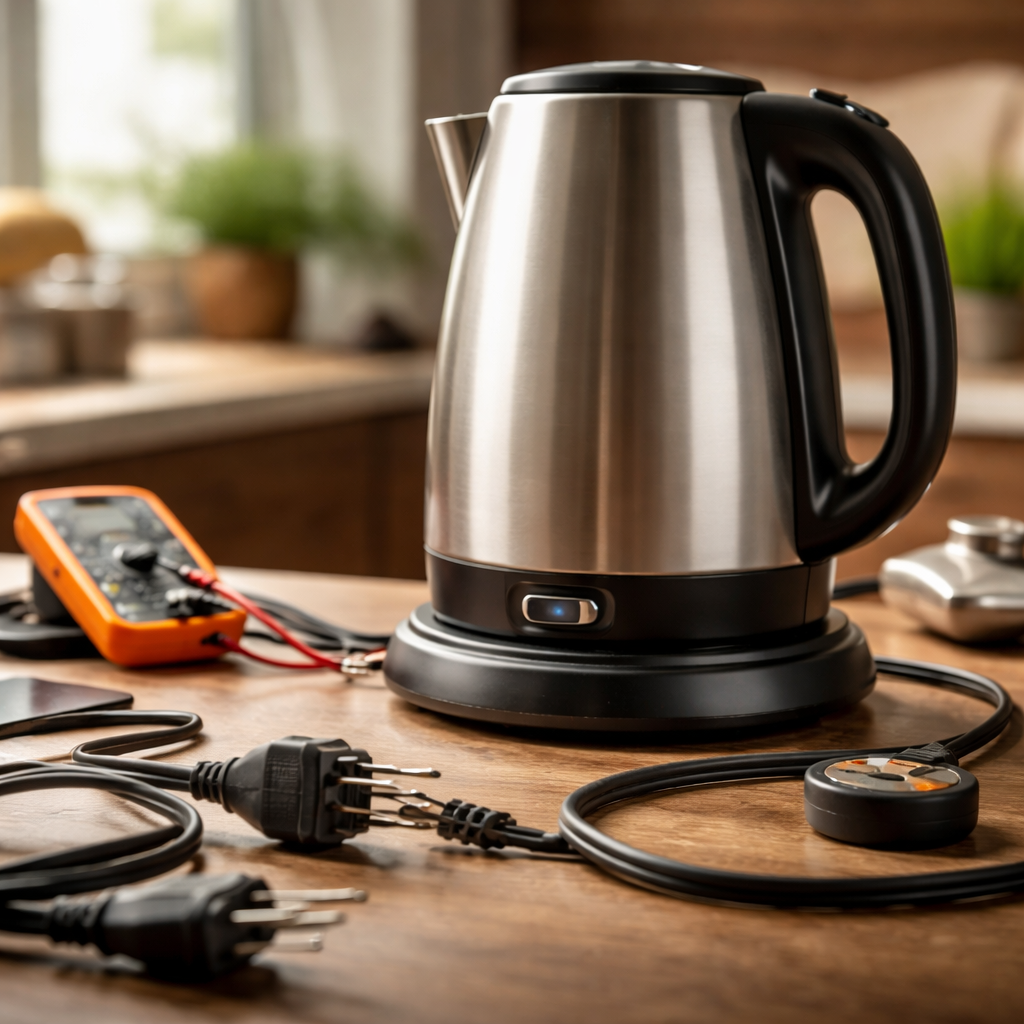
You press the button, nothing happens — and your morning routine comes to a grinding halt. An electric kettle not working is one of those small but genuinely frustrating household problems that most people have no idea how to diagnose, let alone fix. The good news? The majority of kettle failures come down to a handful of common causes, and many of them are surprisingly easy to resolve without calling a technician or buying a replacement.
Start with the obvious: power supply issues
Before diving into the kettle itself, check the basics. A faulty wall socket is responsible for more “broken” appliances than most people realize. Plug the kettle into a different outlet and see if the behavior changes. If you have a switched socket, make sure it’s actually turned on. Also inspect the power cord for any visible damage — fraying, kinks, or burn marks near the plug are red flags that go beyond a simple fix.
It’s also worth resetting your circuit breaker or checking whether a fuse has blown in the plug (in countries where fused plugs are used). These steps take less than two minutes and can save you from a completely unnecessary trip to the store.
The thermal cutoff switch: your kettle’s silent protector
Every modern electric kettle is built with an internal thermal cutoff switch — a safety mechanism designed to shut the appliance down if it overheats or runs without water. This is one of the most common reasons a kettle suddenly stops working. If the kettle was accidentally switched on while empty, this switch may have tripped and locked the device in a protective off state.
Many kettles will not reset automatically after a thermal cutoff event. The unit needs to cool down completely — usually 15 to 30 minutes — before it will operate again. Simply unplugging it and waiting is often all that’s needed.
Once cooled, fill the kettle with the minimum required amount of water (usually marked inside), plug it back in, and try again. If it works normally, the thermal cutoff did exactly what it was supposed to.
Common causes ranked by frequency
Understanding what typically goes wrong helps you troubleshoot faster. Here’s a breakdown of the most frequent failure points:
| Problem | Likely Cause | DIY Fix? |
|---|---|---|
| Kettle won’t turn on at all | Faulty socket, blown fuse, tripped cutoff | Yes |
| Kettle turns off immediately | Overheating, limescale buildup on heating element | Partially |
| Kettle boils but switch doesn’t click off | Worn steam sensor or switch mechanism | No (service needed) |
| Kettle leaks from the base | Cracked body or damaged seal | No (replace unit) |
| Water takes too long to heat | Heavy limescale on the heating element | Yes |
Limescale: the slow killer of heating elements
If you live in a hard water area, limescale is likely your kettle’s biggest long-term enemy. Calcium and magnesium deposits build up on the heating element over time, creating an insulating layer that forces the element to work harder and longer to bring water to boil. Eventually, this leads to overheating, premature cutoff trips, and reduced efficiency.
Descaling is straightforward and should be done regularly — every four to eight weeks depending on your water hardness.
- Fill the kettle halfway with equal parts white vinegar and cold water.
- Bring the mixture to a boil, then switch the kettle off.
- Let the solution sit for 20–30 minutes.
- Pour it out and rinse the kettle thoroughly with fresh water — at least twice.
- Boil a full kettle of plain water once more before using it for drinks.
Citric acid powder works just as effectively as vinegar and leaves no lingering smell — dissolve one tablespoon in a full kettle of water and follow the same process.