
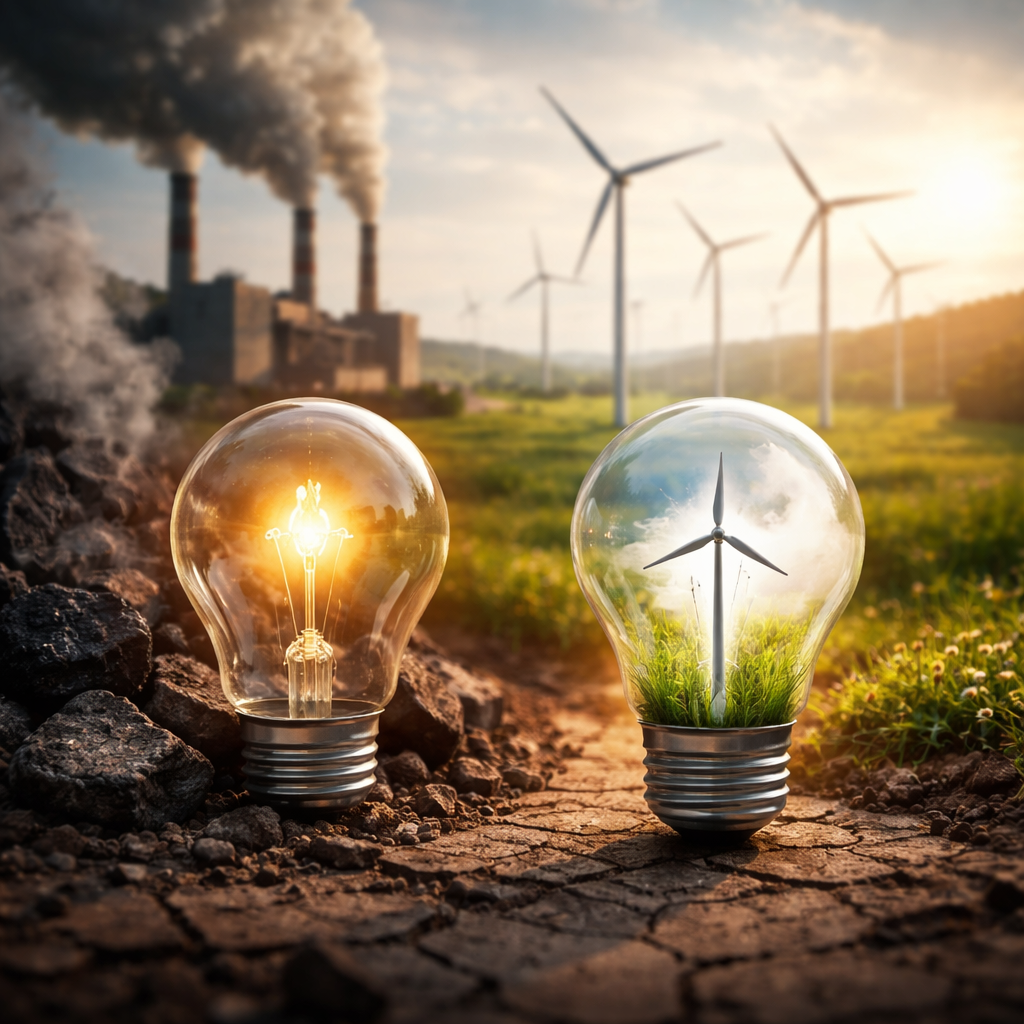
Every time you flip a light switch, something burns somewhere — or it doesn’t. The advantages of wind energy over fossil fuels go far beyond what most people assume when they think about “green power,” and the numbers behind this shift are more striking than any headline suggests.
What wind actually costs — and what coal quietly hides
When energy costs are compared, most people look at the price per kilowatt-hour listed on a utility bill. But that number tells only part of the story. Fossil fuels carry what economists call externalities — costs that don’t appear in the price of electricity but are paid anyway, through healthcare spending, environmental cleanup, and infrastructure damage caused by air pollution and extreme weather events.
Wind energy, by contrast, produces no combustion byproducts. Once a turbine is installed, it generates electricity without consuming any fuel, without emitting carbon dioxide, sulfur dioxide, or nitrogen oxides. The operational cost structure is fundamentally different — and over a turbine’s working lifespan, which typically spans two to three decades, that difference compounds significantly.
A wind turbine installed today will produce electricity for 25 to 30 years with no fuel costs, no carbon emissions, and no combustion waste — something no coal or gas plant can claim.
The resource that never runs out
Fossil fuel reserves are finite. This is not a prediction — it is a geological fact. Oil fields deplete, coal seams thin out, and natural gas extraction becomes more technically demanding and expensive over time. Wind, however, is continuously replenished by atmospheric processes driven by solar energy. It is not possible to “use up” wind the way a coal deposit is exhausted.
This makes wind a genuinely long-term energy source. Countries that invest in wind infrastructure are building capacity that does not depend on import markets, commodity price swings, or geopolitical stability in resource-rich regions. Energy security becomes a domestic matter rather than an international negotiation.
| Factor | Wind Energy | Fossil Fuels |
|---|---|---|
| Fuel cost | Zero (wind is free) | Ongoing, price-volatile |
| CO₂ emissions | Near zero (lifecycle) | High |
| Resource availability | Renewable, unlimited | Finite, depleting |
| Local air quality impact | None during operation | Significant pollutants released |
| Water usage | Minimal | Large volumes required for cooling |
| Energy independence potential | High | Often dependent on imports |
Land use, water, and the things we rarely talk about
Thermal power plants — whether coal, gas, or nuclear — require enormous quantities of water for cooling. In drought-prone regions, this creates a direct conflict between energy production and freshwater availability. Wind turbines require no water during operation whatsoever. In areas already facing water scarcity, this distinction is not a minor detail.
Land use is more nuanced. Wind farms do occupy large areas, but the land between turbines can continue to be used for agriculture or grazing. Farmers in wind-energy regions often lease portions of their land to energy developers while continuing to work the same fields. Coal mines and gas extraction sites, on the other hand, transform the landscape in ways that take generations to reverse — if they reverse at all.
Jobs, communities, and the economic reality on the ground
The employment argument for fossil fuels is real — coal and oil industries have supported communities for generations. But the employment picture for wind energy is also growing. Manufacturing turbine components, installing foundations, maintaining rotating machinery, and managing grid integration all require skilled workers. These are not temporary construction jobs; ongoing maintenance creates permanent local employment.
There is also an important difference in where the money flows. When a region burns coal, a significant portion of the revenue leaves that region to pay for the fuel itself. Wind energy keeps more of the economic activity local — the resource is local, the maintenance is local, and the lease payments go to local landowners.
- Turbine technicians require specialized training and receive above-average wages in most markets
- Local tax revenues from wind projects often fund schools, roads, and community services
- Supply chains for wind components are increasingly domestic in countries with strong manufacturing sectors
- Offshore wind development creates additional specialized employment in coastal communities
The honest trade-offs worth understanding
Wind energy has real limitations, and pretending otherwise helps nobody. Wind is intermittent — turbines produce electricity only when the wind blows within an appropriate speed range. This creates challenges for grid stability that do not exist with dispatchable sources like gas plants, which can be ramped up or down on demand.
Modern grid management addresses this through a combination of approaches: diversified renewable portfolios that include solar, hydro, and geothermal; battery storage systems that are scaling rapidly in both capacity and cost-efficiency; and improved interconnections between regional grids that allow surplus power to flow where it is needed. The intermittency problem is real, but it is an engineering and grid-management challenge rather than a fundamental barrier.
There are also ecological considerations — bird and bat mortality from turbine strikes is documented and studied. Responsible siting, informed by migration data and habitat surveys, significantly reduces this impact. The comparison with fossil fuels remains stark: air pollution and climate-driven habitat loss from combustion affect far larger numbers of species across far larger geographic areas.
Where the energy transition actually stands
Wind energy is not a future technology waiting to become practical. It is already one of the lowest-cost sources of new electricity generation in most parts of the world, according to data from the International Renewable Energy Agency and multiple national energy regulators. In some regions, new wind projects produce electricity at a lower cost per unit than simply operating existing fossil fuel plants — not just compared to building new ones.
The transition away from fossil fuels is not happening because of ideology or regulation alone. It is happening because the economics have shifted, the technology has matured, and the long-term risks of continued combustion dependence — from price volatility to climate impact — have become increasingly difficult to ignore for governments, utilities, and investors alike.
Understanding the full picture — advantages, trade-offs, and the practical realities of grid integration — puts you in a much better position to evaluate the energy choices being made on your behalf, and the ones you might advocate for in your own community.