
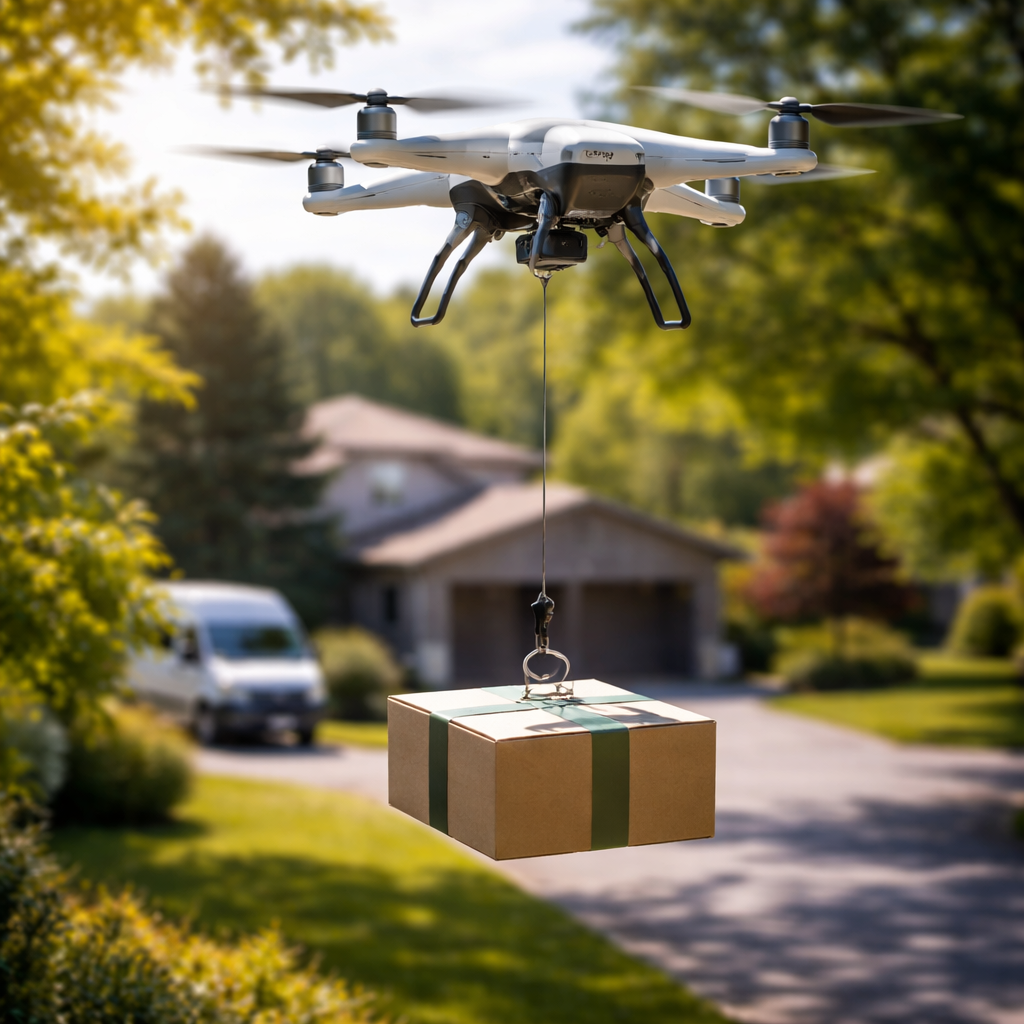
Drone delivery is no longer a concept from science fiction — it’s a logistics shift that major retailers, medical suppliers, and startups are actively building right now. The advantages of using drones in delivery go far beyond speed: they touch cost structure, environmental impact, accessibility, and the fundamental way we think about last-mile logistics. If you’ve ever wondered whether the buzz around delivery drones is justified or just hype, the details below might genuinely surprise you.
Why the last mile is where drones actually shine
The “last mile” — the final leg of a package’s journey from a distribution hub to your front door — is consistently the most expensive and time-consuming part of the entire delivery chain. Traditional delivery trucks stop, start, navigate traffic, and circle blocks looking for parking. A drone simply lifts off and flies in a straight line. For suburban and rural areas especially, this difference in efficiency is dramatic.
In regions where road infrastructure is poor or seasonal weather makes driving unpredictable, drones offer a reliable alternative that doesn’t depend on asphalt at all. This is particularly relevant for healthcare deliveries — blood samples, vaccines, or emergency medications — where timing directly affects patient outcomes.
Real-world performance: what the numbers actually show
Several companies operating commercial drone delivery programs have published operational data that gives a clearer picture of what these systems can actually do in practice:
| Metric | Traditional Delivery (van) | Drone Delivery |
|---|---|---|
| Average delivery time (urban/suburban) | 30–90 minutes | 10–30 minutes |
| CO₂ emissions per delivery | Higher (combustion engine) | Near-zero (electric) |
| Cost per delivery (at scale) | $5–$10+ | Projected $1–$3 |
| Accessibility in remote areas | Limited or impossible | High, regardless of road conditions |
These figures come from publicly reported data by operators like Wing (Alphabet’s drone delivery subsidiary) and Zipline, which has built one of the world’s most extensive drone logistics networks across Rwanda and Ghana for medical supply delivery.
Environmental impact: a genuinely cleaner option
Electric drones produce no direct emissions during flight. Compared to a diesel delivery van making dozens of stops, a drone delivering a single package on a short route has a significantly lower carbon footprint per delivery. Researchers at the University of Washington published findings showing that drone deliveries can generate fewer greenhouse gas emissions than ground-based vehicles, particularly for lightweight packages over short distances.
It’s worth noting that the full environmental benefit depends on how the electricity powering the drones is generated. In regions running on renewable energy, the advantage is clear. Even in grids with mixed energy sources, the efficiency gains often still favor drones for short-range deliveries.
“Drone delivery could reduce energy use per package-kilometer by up to 54% compared to delivery by diesel van for lightweight packages.” — University of Washington transportation research
Access to places that roads simply don’t reach
One of the most underappreciated benefits of autonomous aerial delivery is geographic reach. Mountains, islands, flooded zones, post-disaster areas — these are locations where conventional logistics either breaks down or becomes prohibitively expensive. Drones operate in three-dimensional space and are not constrained by the presence or absence of infrastructure on the ground.
Zipline’s operations in Africa stand as one of the most compelling case studies. The company delivers blood and medical supplies to hospitals in remote areas that previously required hours of travel over rough roads. Response time dropped from several hours to under an hour. That’s not a marginal improvement — it’s a fundamental change in what healthcare delivery can look like.
How drone logistics reduces human risk in delivery operations
Delivery driving is one of the more physically demanding and statistically riskier occupations when it comes to road accidents. Removing human drivers from routine, repetitive delivery routes reduces exposure to traffic-related injuries. In hazardous environments — chemical spills, active emergency zones, extreme weather — drone delivery can substitute for human couriers entirely.
This doesn’t mean drone delivery eliminates jobs entirely. Operational roles shift toward maintenance, fleet management, software oversight, and logistics coordination — positions that are often safer and more technically skilled.
Challenges that are actively being solved
No technology rolls out without friction, and drone delivery is no exception. The current landscape includes real, acknowledged limitations:
- Regulatory frameworks are still evolving in most countries — airspace management for commercial drone fleets requires coordination between aviation authorities and operators.
- Payload capacity is limited — most commercial delivery drones handle packages under 2–5 kg, which covers many e-commerce items but excludes bulkier goods.
- Weather sensitivity — strong winds, heavy rain, and ice affect flight performance and safety.
- Public acceptance and noise — low-flying autonomous aircraft over residential areas raises privacy and noise concerns among some communities.
- Battery range — current technology supports flights of roughly 10–20 km per charge cycle, suitable for urban last-mile but not long-distance routes.
Each of these is an engineering and policy problem being actively worked on. Battery energy density is improving steadily. Regulatory bodies in the US (FAA), EU (EASA), and elsewhere are developing standardized frameworks for beyond-visual-line-of-sight (BVLOS) operations, which is the category that enables truly scalable drone networks.
Industries already using drone delivery at scale
It’s easy to think of drone delivery as something that’s coming. The reality is that it’s already operating commercially across several sectors:
- Healthcare and pharmaceuticals — blood, vaccines, medication, lab samples
- Food delivery — Wing operates food and beverage deliveries in Australia and Finland
- E-commerce — Amazon Prime Air and similar programs are in active testing and limited commercial operation
- Agricultural supply — drone delivery of seeds, pesticides, and tools to remote farm locations
- Disaster relief — delivering emergency supplies in areas cut off by floods or earthquakes
The diversity of these applications reflects something important: drone delivery isn’t a single solution looking for a problem. Different industries discovered independently that aerial logistics solves specific bottlenecks they were already struggling with.
What makes this moment different from previous tech promises
Skepticism toward drone delivery is reasonable — it’s been “five years away” for a long time. But the difference between early announcements and the current situation is that proof-of-concept has given way to operational systems. Zipline has completed millions of deliveries. Wing has tens of thousands of commercial deliveries under its belt. The FAA has issued Part 135 air carrier certificates to drone operators, which is the same certification framework used by passenger airlines.
This isn’t a prototype stage. The infrastructure, regulatory groundwork, and real delivery data are accumulating. The pace of adoption will depend on regulatory decisions and public acceptance as much as on the technology itself — but the technical foundation has crossed a threshold that earlier generations of drone delivery simply hadn’t reached.
Drone delivery works best not as a replacement for all logistics, but as a precision tool for specific delivery contexts where speed, access, or safety make it the most practical option available.
The practical takeaway for businesses and everyday consumers
For businesses evaluating logistics options, drone delivery is worth tracking seriously — not as a distant future investment, but as a near-term possibility in specific corridors and use cases. For consumers, the changes will arrive gradually and will likely feel unremarkable when they do: a package arriving in 15 minutes rather than two days, or a prescription showing up the same afternoon it was ordered.
The technology is not waiting for permission to be useful. It’s already proving its value in medical logistics, food delivery, and e-commerce. As airspace regulations mature and drone hardware continues to improve, the question won’t be whether drone delivery scales — it’ll be how quickly the logistics industry adapts around it.